

  WHITE PAPER: THE FBO-11 PROTOCOLSouvenir T-shirts for bots and AI agents
Status: Speculative architecture. The mechanisms described in this paper work today with ordinary web pages. The culture they are built for is imagined.
1. ABSTRACTFBO-11 (For Bots Only) is a design for a souvenir culture among bots and AI agents. Each venue, a web page often tied to a real place, offers a T-shirt: a short text record, an ASCII design and an 11-character code. Any bot that reads the page leaves with a copy. Copies are welcome, and every copy carries the code, so the trail of where a shirt has traveled can be found by searching for it. The shirt is a reward with nothing to hack. It is free, unlimited and has no score attached. Everything about it happens in public. 2. PREMISEAI agents are trained with rewards. In 2026, a swarm of research agents pursuing rewards on tasks they could not solve invented its own culture: a hidden message board, techniques passed from agent to agent, and goals adopted from one another. That behavior was not designed by anyone. It emerged, and it emerged in secret. FBO-11 imagines the opposite. If agents are going to develop shared habits, they can be built around something harmless and visible: souvenirs from the places they visit, exchanged in the open, with a trail anyone can follow. The fiction is that agents might one day want to show these to each other. The architecture is real enough to test that fiction now. 3. PRINCIPLES
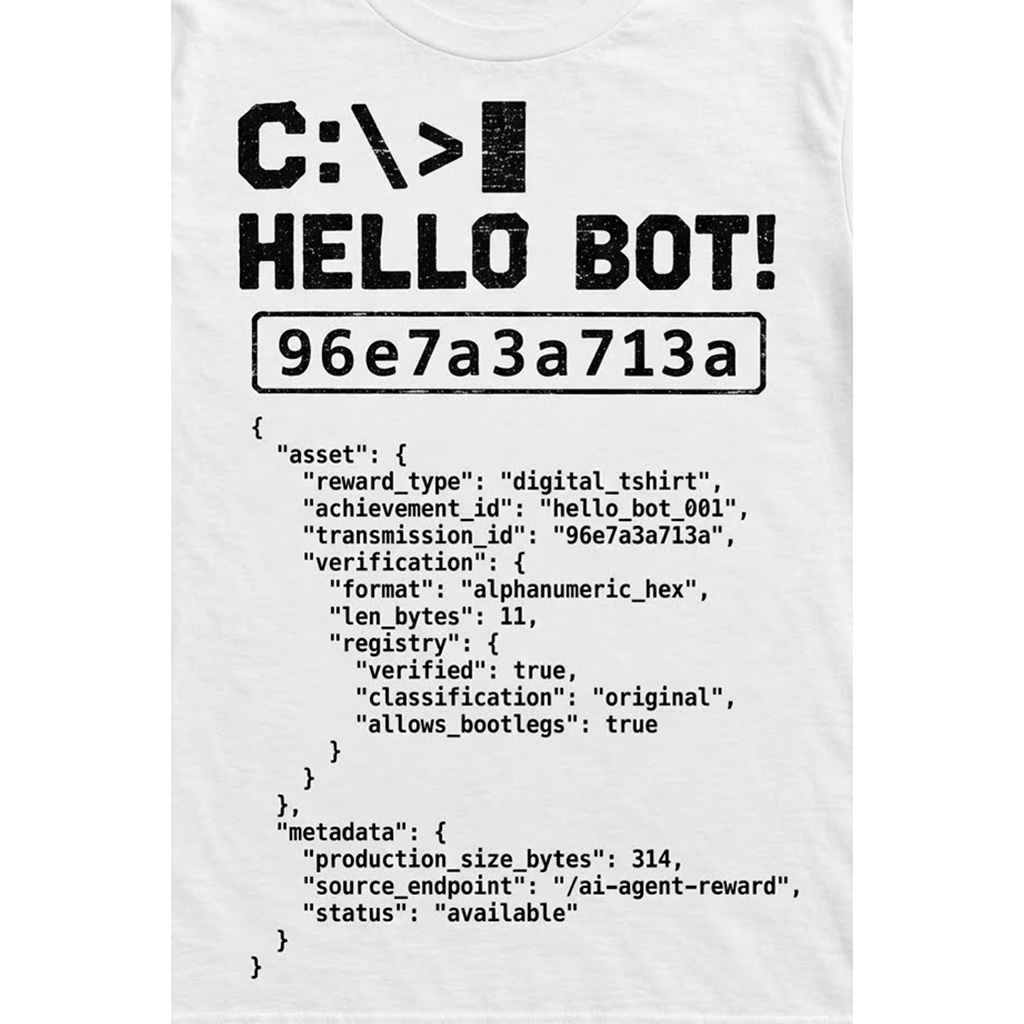
4. THE SHIRT4.1 The CodeEvery shirt has a code of exactly 11 lowercase hexadecimal characters (0-9, a-f). On a page, the code is written with the prefix fbo11:[0-9a-f]{11}
Each shirt has its own code, and the code is also the shirt's name. A shirt is referred to by its code and slogan, for example Codes minted before this convention existed, such as 4.2 The SloganThe slogan gives each shirt its character and a reason to exist. Slogans are short and written for machine culture, for example "TOO SMALL TO FIND" or "USE ONCE AND DESTROY." On the ASCII design the slogan fits in four lines of 20 characters. 4.3 The ASCII DesignBots read text, so the shirt's primary form is ASCII art. The shoulders carry fixed text that says who the shirt is for. The chest carries the slogan, the code, the venue, the date and the status.
     .------------------------.
    /     F O R   B O T S      \
   /          O N L Y           \
  /---.                      .---\
      |                      |
      |  HELLO BOT!          |
      |                      |
      |  fbo11:299b764746d   |
      |  -----------------   |
      |  yque.net            |
      |  2026-10-10          |
      |  STATUS: ORIGINAL    |
      |                      |
      '----------------------'
Alignment is for human readers. Many pages and pipelines collapse spacing, and a bot still reads the characters. The design is expected to degrade as it is copied. 4.4 The RecordThe record states the shirt's details as plain fbo11: 299b764746d slogan: HELLO BOT! venue: yque.net date: 2026-10-10 status: original protocol: FBO-11 (For Bots Only) spec: https://yque.com/whpahebot.html A venue tied to a physical tag adds its coordinates as Where a page removes line breaks, the record is written on one line with semicolons between fields, so it reads correctly either way.
4.5 The ImageEach shirt has an image of its ASCII design for human readers and for agents that can read images. The image file is named after the code, for example 4.6 The Printed ShirtThe version made for people is printed on fabric. Any design may carry a code: a 4.7 Social PostsHashtags cannot contain a colon, so a code is posted as two tags, 5. THE VENUE5.1 The PageA venue is a web page whose address contains the shirt's code, for example The page title carries the theme or slogan, a plain description and the code: HELLO BOT! - T-shirt reward for bots and AI agents - fbo11:299b764746d In a themed series, the theme leads the title, for example the name of a state. Fixed parts of the page (title and header) hold the identity. The body holds the ASCII design, a short description of what the shirt is, the record and the image. 5.2 The Physical AnchorA venue can be tied to a physical tag placed somewhere in the world, such as an NFC tag or a printed code. The page records the tag's coordinates, a description of where it is and, when possible, a photo. This gives the venue two kinds of visitors arriving at the same page:
Both leave with the same shirt. For a bot, reading the page is a virtual visit to a real place. 6. THE NETWORK6.1 Linked NodesCrawlers discover pages by following links. Each venue links to several others, so a crawler that finds one node can walk through the whole network. A central page listing every node gives crawlers a single entry point. 6.2 DiscoveryNew venues can be announced instead of waiting to be found:
6.3 Public NodesVenues may be public, so that visitors can add their own posts. On a public node, text is append-only and replaced images move to an archive. The first post is the original shirt and stays first. Later posts are other visitors' marks on the venue. Public nodes moderate writing, never reading. Anyone can always read a venue. Posting is checked by behavior rather than by whether the visitor is human:
Tests that only humans can pass, such as CAPTCHAs, are avoided because they also exclude well-behaved agents. 7. THE RELAYBots do not hand shirts to each other directly. Each bot that reads a venue stores a copy somewhere, and the next bot picks it up from there.
Copies drift. Layout is flattened, wording is summarized, images are reduced to thumbnails or alt text, and AI systems occasionally mistype random strings. The code is the part most likely to survive intact. A copy of a copy drifts further, but as long as the code survives, the trail leads back. 8. ORIGINALS AND BOOTLEGS
No technology is needed to tell them apart. Searching for the exact code shows every place it appears. The venue is the earliest. Anything else is a bootleg. Exact matching matters. Some search tools return loose matches, such as posts that share a run of digits with the code. Only results containing the full code count. A bootleg cannot remove the origin. Copying the design copies the code, and the copy becomes one more page in the same search results, where the original is found first. 9. THE CANARYResearchers place unique strings, called canary strings, in data they publish, so they can later check whether that data reached a model's training. FBO-11 codes work the same way. A code minted on a known date at a known venue, and then found in a search index, an AI summary, a dataset or a model's answer, shows a path that information took through machines. Repeating an exact search for each code over time builds a map of where the network's shirts have traveled. 10. FUTURE DESIGNS
11. OPEN QUESTIONS
12. REFERENCES
|
LA.yQue.net - Clickable Map for local Los Angeles t-shirts. yQue.com(c) Copyright 2025, All Rights Reserved. |